by Dean Cheong
Share

Even the most technologically advanced nations in the world recognize the sheer power of incorporating here. As a recent South China Morning Post report highlighted, highly digitized Estonian start-ups are actively eyeing Singapore as the “natural gateway” to build digital trust and scale their operations across the ASEAN region.
Singapore consistently ranks as one of the best places on Earth to launch a business. But before you can secure your first client, hire a team, or tap into that ASEAN gateway, you have to make a foundational decision: choosing your business structure.
“Choosing the wrong entity can result in overpaying on taxes, exposing yourself to personal liability, and creating massive administrative roadblocks when you try to scale.”
If you are comparing a Pte Ltd vs LLP in Singapore, you are already looking at the two most robust options. This guide breaks down the exact differences in costs, tax implications, and legal liabilities so you can make an informed, ACRA-compliant choice from day one.
The Quick Answer: Pte. Ltd. vs. LLP Comparison Matrix
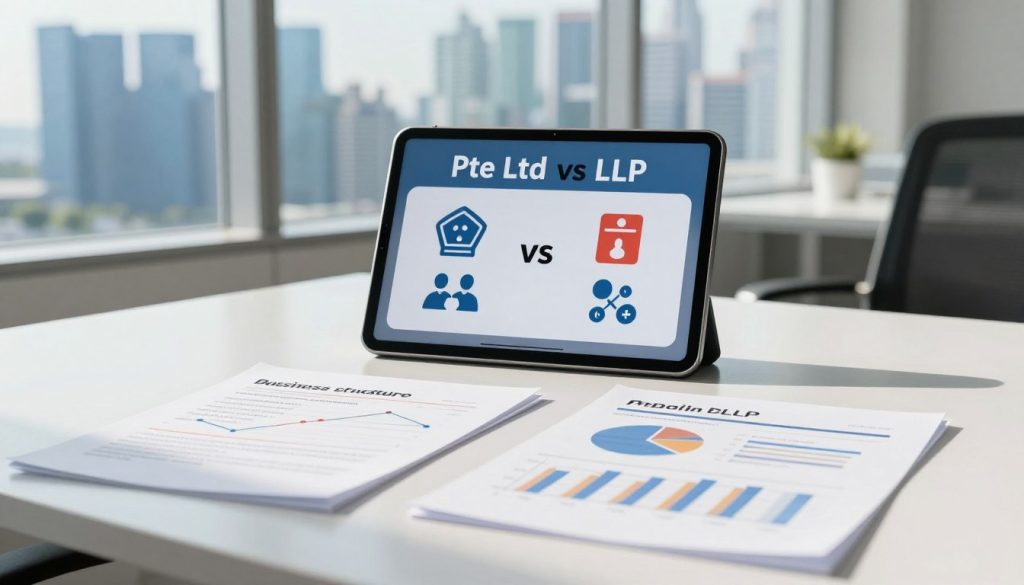
Understanding the differences between a Pte Ltd vs LLP Singapore is key for success. Each structure has its own benefits based on your goals and risk level. Learn more in our guide to business structures.
The main difference is in liability protection. A Private Limited company protects personal assets from business debts. An LLP offers a mix of partnership flexibility and limited liability for partners.
Think about the tax implications Singapore has for each. Private Limited companies get good tax rates and exemptions. LLPs are taxed on partner income, affecting your finances based on your earnings.
This table helps your team choose the right structure for your company.
| Feature | Private Limited Company (Pte. Ltd.) | Limited Liability Partnership (LLP) |
| Legal Status | Separate legal entity from its owners. | Separate legal entity from its partners. |
| Owners/Partners | 1 to 50 shareholders. | Minimum 2 partners, no maximum limit. |
| Personal Liability | Limited to the amount of share capital invested. | Limited to the partner’s capital contribution. |
| Tax Structure | Corporate Tax (Flat 17%, plus exemptions). | Personal Income Tax (Progressive, up to 24%). |
| Compliance Load | High (Requires a Company Secretary, AGMs). | Low (No Company Secretary or AGMs required). |
| Raising Capital | Excellent (Can easily issue shares). | Difficult (Cannot issue shares; funded by partners). |
Deep Dive: Private Limited Company (Pte. Ltd.)
A Private Limited Company is by far the most popular and scalable business structure in Singapore. It is a separate legal entity limited by shares, meaning the company can buy property, sue, or be sued in its own name.
The Wealth-Building Advantage (Tax)
Singapore is famous for its flat 17% corporate tax rate. However, the massive advantage for new Pte. Ltd. companies is the Start-Up Tax Exemption (SUTE) scheme. Under SUTE, eligible startups receive significant tax exemptions on their first $200,000 of normal chargeable income for their first three consecutive Years of Assessment (YAs).
Pro Tip: You can learn exactly how to qualify for this in our comprehensive guide on maximizing your Start-Up Tax Exemption benefits.
The Protection Advantage
There is a complete firewall between your personal assets and your business debts. If the business goes under or faces a lawsuit, your personal savings, home, and assets remain fully protected.
The Catch (Compliance)
This protection and scalability come with stricter rules. The Accounting and Corporate Regulatory Authority (ACRA) and the Inland Revenue Authority of Singapore (IRAS) require you to:
- Appoint at least one ordinarily resident Director.
- Appoint a qualified, local Company Secretary within 6 months of incorporation.
- Hold Annual General Meetings (AGMs) and file Annual Returns.
Deep Dive: Limited Liability Partnership (LLP)
An LLP is essentially a hybrid model. It gives owners the flexibility of operating as a traditional partnership while maintaining a separate legal identity to provide limited liability protection.
The Flexibility Advantage
An LLP is much easier to maintain than a Pte. Ltd. There are no shares to distribute, no strict requirements to hire a local Company Secretary, and no need to hold formal AGMs.
The Trap
Because an LLP is a partnership, it does not pay corporate tax. Instead, profits are distributed to the partners and taxed as personal income. While this might seem harmless initially, Singapore’s personal income tax rates are progressive and can climb up to 24% for high earners. If your business becomes highly profitable, you will end up paying significantly more in taxes than the 17% corporate rate.
Need a deeper breakdown? Check out our earlier analysis on Singapore personal vs. corporate tax structures to see how these brackets impact your bottom line.
CPF Implications
It is also critical to note that active partners in an LLP are considered self-employed. You must make mandatory Medisave (CPF) contributions based on your net trade income before you can renew your business registration.
Real-World Scenarios: Which Structure Fits Your Strategy?
Choosing between a Pte. Ltd. and an LLP is rarely a generic decision—it depends entirely on your business model, your risk profile, and your exit strategy. Here is how the debate plays out across three very common entrepreneurial scenarios in Singapore:
Scenario A: The High-Growth Tech (or SaaS) Startup
- The Verdict: Private Limited Company (Pte. Ltd.)
- The Strategy: If your goal is to build an app, a software platform, or a disruptive tech product, you will likely need to burn through cash before you turn a profit. This means you need outside capital.
- Why it works: Venture capitalists (VCs) and angel investors will only invest in a Pte. Ltd. They inject capital in exchange for equity (shares). An LLP cannot issue shares. Furthermore, a Pte. Ltd. allows you to issue different classes of shares (e.g., preference shares for investors, ordinary shares for founders) and create Employee Stock Ownership Plans (ESOPs) to attract top-tier tech talent.
Pro Tip: Government grants are also a factor here. Lucrative schemes like the Startup SG Tech grant or the Enterprise Development Grant (EDG) are generally geared toward incorporated private limited companies, not partnerships.
Scenario B: The Boutique Professional Services Firm
- The Verdict: Limited Liability Partnership (LLP)
- The Strategy: This is the go-to structure for specialized agencies, law firms, architectural practices, and accounting firms where 2 to 4 seasoned professionals are pooling their networks and resources.
- Why it works: In an LLP, you don’t need external venture funding; your capital is your expertise. The LLP structure allows partners to draw up a flexible partnership agreement to distribute profits however they see fit, rather than being strictly tied to share ownership percentages. Crucially, an LLP protects you from the negligence of your other partners. If Partner A makes a professional error and is sued, Partner B’s personal assets—and the overall assets of the LLP—are protected.
- The Tipping Point: Many consultancies stay as LLPs until their net profits become so high that the partners’ personal income tax brackets (which cap at 24%) exceed the flat 17% corporate tax rate. At that point, they often transition to a Pte. Ltd.
Scenario C: The Solo E-commerce or Import/Export Founder
- The Verdict: Private Limited Company (Pte. Ltd.)
- The Strategy: You might be starting alone at your kitchen table, but if you are dealing with physical products, cross-border shipping, and international suppliers, your risk exposure is surprisingly high.
- Why it works: Liability is the biggest factor here. If an overseas supplier breaches a massive contract, or a customer is injured by a defective product you imported and sues your brand, a Pte. Ltd. provides a critical firewall. Your maximum loss is the capital you put into the company; your personal savings and property remain untouched. Additionally, e-commerce revenues can scale exponentially. Utilizing the Start-Up Tax Exemption (SUTE) allows you to reinvest those early profits back into inventory and marketing almost entirely tax-free.
If your business model doesn’t perfectly fit into one of these boxes, don’t leave your structure to chance. Contact hub.com.sg today to discuss your vision with our incorporation experts and find the exact right fit for your goals.
The “Hidden” Costs of Incorporation
Starting a business in Singapore means facing ongoing costs. The first fee is just the beginning. The real costs come later and affect your company’s health. Planning for these costs early helps you grow stronger.
Staying compliant is an ongoing task. You need to follow rules like having a qualified secretary and filing annual reports. Missing these deadlines can cost you money and hurt your profits.
Taxes and audits also impact your finances. Singapore’s tax rates are good, but you must understand tax rules and deadlines. Knowing these helps you save money and grow your business.
“Financial foresight is the cornerstone of sustainable growth; by anticipating the costs of compliance today, you secure the freedom to innovate tomorrow.”
Seeing these costs as investments is key. A solid corporate structure attracts investors and partners. Budgeting for these costs from the start keeps your business strong and compliant in Singapore.
Can I Change My Mind Later? (Converting an LLP to a Pte. Ltd.)
Changing from an LLP to a Private Limited company is common for growing businesses in Singapore. As your business grows, a corporate entity might better meet your goals. This LLP conversion is a formal process that needs careful planning to keep your business legal.
Deciding to change means starting over. You’re creating a new legal entity to take over your business. You need to file new documents to register your Pte. Ltd. company and close the old partnership.
Transferring assets and liabilities is key to a smooth LLP conversion. Make sure all contracts, bank accounts, and intellectual property are moved to the new company. Not doing this right can cause problems or legal issues.
“Agility in business structure is not just about starting correctly; it is about having the foresight to adapt your legal framework as your market influence and operational complexity grow.”
It’s wise to talk to a corporate secretary or lawyer for your LLP conversion. Preparing your documents early helps avoid delays. This way, your business can keep running smoothly during the change.
Frequently Asked Questions
Do I need a local director for both structures?
For a Pte. Ltd., yes. You must have at least one director who is ordinarily resident in Singapore (a Citizen, Permanent Resident, or an EntrePass/Employment Pass holder). For an LLP, you must have at least one local “manager” who is ordinarily resident in Singapore, though the partners themselves can be foreigners.
Which structure is better for foreign business owners?
A Pte. Ltd. is overwhelmingly the preferred choice for foreign entrepreneurs. It allows for 100% foreign ownership and makes it significantly easier to apply for an Employment Pass (EP) to relocate and work in Singapore.
Are LLPs eligible for the Start-Up Tax Exemption (SUTE)?
No. Only qualifying Private Limited Companies (Pte. Ltd.) can take advantage of the SUTE scheme and flat corporate tax rates. LLPs are taxed at the personal income tax level of the individual partners.
Ready to Make It Official? Let’s Build Your Business Properly from Day One.
Understanding the theory between a Pte. Ltd. and an LLP is the first step. Executing the ACRA paperwork, structuring your tax strategy, and maintaining flawless compliance is where the real work begins.
Whether you are locking down a lean LLP or scaling globally with a Pte. Ltd., Hub Corporate Services acts as your dedicated back-office. We handle the red tape, act as your Company Secretary, and manage your annual filings so you can focus entirely on growing your business.
Don’t let compliance gaps or tax inefficiencies slow you down. Explore our Singapore company incorporation services today to get your business registered fast, flawlessly, and without hidden fees.
Simplify your business compliance today.
Navigating Singapore’s regulatory landscape doesn’t have to be a solo journey. From seamless incorporation to complex tax advisory, Hub is the partner you can count on. Call us today at +65 8121 2113
STAY IN THE LOOP
Subscribe to our free newsletter.

Declare your UBO to ACRA in Singapore with confidence. Our step-by-step instructions make the process easy.

Establish a Singapore family office with our comprehensive guide. Leverage 13O & 13U regulations for optimal setup and compliance.

Expand your business globally with our Singapore corporate tax expertise. Uncover compliance best practices and growth strategies.

Businesses engaging overseas individuals for board roles must navigate a [...]