by Dean Cheong
Share
by Dean Cheong
Share

Changing your registered address in Singapore appears straightforward until you encounter the full scope of compliance requirements. Business owners frequently assume updating ACRA completes the process. This misconception creates significant regulatory exposure.
The reality involves coordinating updates across multiple government agencies, financial institutions, and business stakeholders. Missing even one notification channel can trigger penalties, disrupt operations, or compromise your company’s legal standing.
This guide provides the authoritative framework compliance managers and operations leaders require. We examine statutory obligations, identify every entity requiring notification, and outline practical implementation steps that protect your business from regulatory risks.
Understanding Registered Address Requirements in Singapore
Your registered address represents your company’s official legal domicile under Singapore’s regulatory framework. This designation carries specific compliance obligations that extend beyond simple mail reception.

Legal Definition and Purpose
The Accounting and Corporate Regulatory Authority defines a registered address as the official location where your company receives statutory notices, legal documents, and government correspondence. This address appears on all public company records.
Regulatory authorities use this address to serve legal notices. Commercial partners verify business legitimacy through registered address validation. Banking institutions cross-reference this information during compliance reviews.
ACRA Compliance Standards
Singapore law mandates that every registered address must meet three fundamental criteria. The address must be physically located within Singapore’s territorial boundaries. It cannot be a post office box or virtual mailbox service lacking physical access.
The location must remain accessible to the public during normal business hours. This accessibility requirement means someone must be available to receive official documents and correspondence at the address during standard operating periods.
Physical accessibility serves a critical compliance function. Regulatory bodies and legal representatives must be able to deliver time-sensitive notices. If authorities cannot access your registered address during business hours, your company faces potential compliance violations.
Common Address Types
Most Singapore companies select from several standard address configurations. Traditional office spaces provide straightforward compliance. The business operates from and maintains its registered address at the same physical location.
Virtual office providers offer registered address services for companies without dedicated physical premises. These arrangements must include proper mail handling and document reception capabilities. Not all virtual office configurations meet ACRA’s accessibility standards.
Some businesses designate their corporate secretary’s office as the registered address. This approach centralizes compliance management. However, it requires ensuring the corporate secretary maintains appropriate accessibility and notification protocols.
When Changing Your Registered Address Becomes Mandatory
Specific circumstances trigger the legal obligation to change your registered address in Singapore. Understanding these trigger events helps prevent inadvertent compliance violations.

Office Relocation Scenarios
Physical relocation to new business premises creates an immediate address change obligation. When your company moves to a different location, you must update your registered address within fourteen days. This timeframe begins from the effective date of your new address, not when you complete the physical move.
Lease termination at your current registered address requires proactive address updating. You cannot allow your registered address to become invalid due to lease expiration. Planning your address transition before lease termination protects against compliance gaps.
Service Provider Changes
Switching from one virtual office provider to another constitutes an address change requiring ACRA notification. The new provider’s address must be updated through official channels. Assuming automatic transfer between providers creates regulatory exposure.
If your current address provider ceases operations or no longer meets accessibility requirements, you must secure and register a new compliant address. Delayed action during provider transitions represents a common compliance failure point.
Accessibility Requirement Failures
When your current address becomes inaccessible during business hours, it no longer satisfies regulatory standards. This situation might arise from building access restrictions, security protocol changes, or operational hour modifications. Proactive address updating before accessibility lapses demonstrates proper compliance management.
Immediate Action Required
These situations demand prompt address updating to maintain compliance status.
- Physical office relocation to new premises
- Lease termination at registered address location
- Virtual office provider service discontinuation
- Building access restrictions preventing public accessibility
Planned Transition Scenarios
These circumstances allow strategic timing but require definitive action.
- Upgrading to larger office accommodations
- Consolidating multiple locations to single address
- Transitioning from home office to commercial space
- Changing corporate secretary service providers
Compliance Risk Events
Address changes prompted by regulatory or operational requirements.
- Current address no longer meets ACRA standards
- Banking institution requests updated business location
- Licensing authority requires address verification
- Audit findings identifying address discrepancies
Strategic Business Changes
Business evolution scenarios necessitating address updates.
- Business expansion into new operational territories
- Restructuring requiring centralized administration
- Professional image enhancement through premium address
- Cost optimization through shared office arrangements
The Fourteen-Day Compliance Window
Singapore’s regulatory framework provides a fourteen-day window for registered address updates. This period begins when your new address becomes effective, not when you decide to make the change. Missing this deadline exposes your company to penalties and compliance violations.
The fourteen-day requirement applies regardless of address change circumstances. Whether relocating for growth or changing providers for cost efficiency, the timeline remains constant. Compliance managers should initiate the change process immediately upon determining the effective date of the new address.
Who to Notify When You Change Registered Address Singapore
Updating your registered address extends far beyond the initial ACRA filing. Comprehensive compliance requires coordinated notification across multiple regulatory authorities, financial institutions, and business stakeholders.
Primary Regulatory Authority: ACRA
The Accounting and Corporate Regulatory Authority represents your mandatory first notification. This update establishes your new official registered address in Singapore’s corporate registry. All subsequent notifications build upon this foundational change.
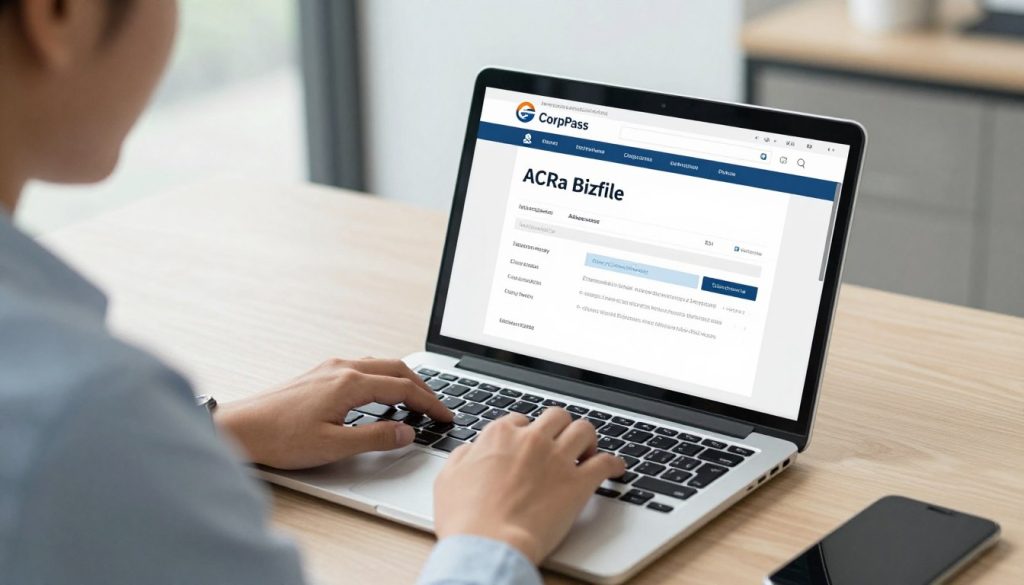
You must complete the ACRA registered address change through the Bizfile portal using your company’s CorpPass credentials. The system requires specific information including your new complete address, the effective date of the change, and confirmation that the new location meets accessibility requirements.
Filing delays beyond fourteen days trigger automatic penalties. ACRA’s enforcement approach treats address update failures as serious compliance breaches. Your company’s regulatory standing reflects address update timeliness.
Tax Authority: Inland Revenue Authority of Singapore
IRAS must receive notification of your registered address change to ensure proper tax correspondence routing. The authority uses your registered address for corporate income tax notices, GST-related communications, and filing requirement notifications.
Tax authorities consider documents legally served when delivered to your registered address. If IRAS sends assessment notices or filing reminders to an outdated address, you remain liable for meeting deadlines despite non-receipt. This legal principle makes prompt IRAS notification essential for tax compliance protection.
The notification process involves logging into your IRAS corporate tax account and updating your company particulars. While ACRA and IRAS systems eventually synchronize, proactive direct notification eliminates the risk of missed communications during the synchronization period.
Financial Institutions and Banking Partners
Singapore banks maintain strict Know Your Customer requirements that include current registered address verification. Your corporate bank account records must reflect your accurate business location for compliance monitoring and transaction processing.
Outdated address information in banking systems can trigger compliance reviews or transaction holds. Financial institutions use registered address data to verify business legitimacy and assess operational risk profiles. Discrepancies between ACRA records and banking information raise automated flags in compliance monitoring systems.
Contact your relationship manager or business banking support to update your company profile. Most banks require supporting documentation confirming the ACRA address change. Processing typically takes five to seven business days after document submission.
Central Provident Fund Board
Companies employing staff in Singapore must notify the CPF Board of registered address changes. The board maintains employer records that include your official business location. Accurate address information ensures proper processing of CPF contributions and employer correspondence.
While CPF systems eventually receive ACRA updates through government data sharing, direct notification prevents administrative complications. Update your employer profile through the CPF e-Services portal using your company’s CorpPass access.
Licensing and Regulatory Bodies
Businesses operating under specific licenses must verify whether their authorizing bodies require address change notification. Financial services providers, food and beverage operators, educational institutions, and healthcare facilities typically face license-specific address requirements.
Some licenses tie operational authorization to specific physical locations. In these cases, changing your registered address might require license amendments or reapplications. Review your industry-specific licensing requirements to identify additional notification obligations.
| Authority/Entity | Notification Priority | Deadline | Consequence of Non-Compliance |
| ACRA | Mandatory | 14 days | Financial penalties, compliance breach |
| IRAS | Critical | Immediate | Missed tax notices, potential penalties |
| Corporate Bank | High | Within 30 days | Transaction delays, compliance holds |
| CPF Board | Required (if employing) | Within 30 days | Administrative complications |
| Business Partners | Recommended | As soon as practical | Operational disruptions, invoice issues |
| Industry Regulators | License-dependent | Varies by authority | License validity questions |
Commercial Stakeholders
Your business partners, vendors, and clients should receive notification of your registered address change. This communication prevents invoice discrepancies, contract documentation issues, and operational confusion.
Key commercial stakeholders include suppliers with ongoing contracts, major clients requiring updated vendor information, professional service providers, and insurance companies maintaining your business policies. Systematic stakeholder notification demonstrates professional business management and prevents transactional complications.
Managing Multiple Stakeholder Notifications?
Our compliance experts help businesses navigate the complete address change process, ensuring all required notifications are completed accurately and on time.
Step-by-Step Process to Change Registered Address Singapore
Executing a compliant registered address change requires systematic approach and attention to procedural details. This framework ensures you complete each requirement correctly.
Pre-Change Preparation
Before initiating your address change, verify that your new location meets all ACRA requirements. Confirm the address is a physical Singapore location with proper accessibility during business hours. Ensure you have all necessary documentation including proof of new address occupancy rights.
Gather your company’s CorpPass credentials and verify your authorization level permits filing corporate information changes. If using a corporate secretary, confirm they have current access to your company’s Bizfile account.
ACRA Filing Through Bizfile
Access the Bizfile portal using your company’s CorpPass login credentials. Navigate to the company information update section and select the registered address change option. The system requires your complete new address including unit number, building name, street name, and postal code.
Specify the effective date of your address change. This date determines your fourteen-day compliance window. Review all entered information carefully before submission. Address filing errors can delay approval or require resubmission.
The system generates a filing reference number upon successful submission. Retain this reference for your compliance records. ACRA typically processes standard address changes within one to two business days.
Parallel Notification Execution
While awaiting ACRA confirmation, begin notifying other authorities and stakeholders. This parallel processing approach minimizes total transition time. Access your IRAS corporate tax account and update your company particulars with the new registered address.

Contact your corporate bank’s relationship manager or business support team. Submit the required address change documentation, which typically includes the ACRA confirmation letter and board resolution approving the address change. Request written confirmation of the bank’s address update completion.
If employing staff, update your CPF employer profile through the e-Services portal. This ensures continued smooth processing of employee CPF contributions.
Commercial Stakeholder Communication
Prepare standardized communication for business partners and vendors. Your notification should include the effective date of the address change, your complete new registered address, and confirmation that all other company details remain unchanged.
Key vendors and major clients warrant direct communication through email or formal letter. General stakeholder notification can occur through website updates, email signatures, and revised letterhead. Systematic stakeholder notification prevents invoice routing issues and payment delays.
Documentation and Record Keeping
Maintain comprehensive records of all address change actions. File copies of the ACRA confirmation, IRAS update confirmation, banking correspondence, and stakeholder notifications. This documentation proves compliance during audits and addresses any future discrepancy questions.
Update all company documents bearing the registered address including letterheads, business cards, website content, email signatures, and contract templates. Document consistency across all business materials reflects professional operations management.
Compliance Risks and Penalties for Delayed Address Updates
Failing to update your registered address within required timeframes creates substantial regulatory and operational risks. Understanding these consequences helps prioritize proper address management.
Financial Penalties and Regulatory Sanctions
ACRA imposes financial penalties for late registered address updates. The penalty structure escalates with delay duration. Companies missing the fourteen-day deadline face immediate fines. Prolonged non-compliance triggers increased penalties and potential director liability.
Beyond direct financial penalties, compliance violations enter your company’s regulatory record. This compliance history affects future dealings with authorities. Repeated violations can trigger enhanced scrutiny during corporate filings and increased regulatory oversight.
Legal Notice Delivery Complications
Singapore law considers legal notices properly served when delivered to your registered address. This principle applies even when you never receive the actual document due to an outdated address. Court documents, regulatory notices, and statutory communications sent to your old address still carry full legal effect.
Missing critical legal notices due to outdated address information creates serious liability exposure. Judgment defaults, compliance deadlines, and legal proceedings can advance without your knowledge. The resulting complications far exceed simple address update administrative requirements.
Tax Compliance Exposure
IRAS sends tax assessments, filing reminders, and compliance notices to your registered address. When these communications reach an outdated address, you miss critical tax deadlines. Late filing penalties, incorrect tax submissions, and potential audit triggers result from missed IRAS correspondence.
Tax authorities do not waive penalties based on non-receipt arguments when your registered address was outdated. The responsibility for maintaining current address information rests with your company. Proper address management represents fundamental tax compliance protection.
Banking and Financial Service Disruptions
Banks conduct ongoing compliance monitoring of corporate customers. Address discrepancies between ACRA records and banking files trigger automated compliance alerts. These alerts can result in transaction delays, account reviews, or temporary service restrictions while the bank investigates the discrepancy.

Financial institutions must verify that customer information remains current and accurate. Material discrepancies in core identification data like registered address can prompt enhanced due diligence procedures. These reviews disrupt normal banking operations and may delay time-sensitive transactions.
Operational and Commercial Impacts
Outdated registered addresses create practical operational complications. Vendors and clients attempting to verify your business legitimacy find inconsistent information across different sources. This inconsistency raises questions about your company’s professionalism and attention to compliance matters.
Contract execution, invoice processing, and payment routing all depend on accurate address information. Discrepancies between your registered address and operational documentation can delay payments, complicate contract administration, and create unnecessary stakeholder friction.
Timely Address Update Benefits
- Maintains full regulatory compliance status
- Ensures receipt of all official correspondence
- Prevents financial penalties and sanctions
- Supports smooth banking operations
- Demonstrates professional business management
- Protects against legal notice complications
Delayed Update Consequences
- Immediate ACRA financial penalties
- Missed critical tax and legal notices
- Banking compliance holds and delays
- Enhanced regulatory scrutiny
- Operational disruptions with stakeholders
- Professional credibility damage
Common Mistakes When Changing Registered Address Singapore
Even experienced operations managers encounter pitfalls during registered address changes. Recognizing these common errors helps you avoid unnecessary complications.

Assuming ACRA Update Completes All Requirements
The most frequent mistake involves believing that updating ACRA automatically notifies all other relevant authorities. While government agencies eventually share data, synchronization delays create dangerous compliance gaps. Proactive direct notification to IRAS, banking partners, and other stakeholders eliminates these risks.
Each authority maintains independent records requiring separate updates. Relying on automatic data sharing introduces uncertainty about notification timing and completeness. Systematic direct notification to each required entity provides certainty and demonstrates proper compliance management.
Missing the Fourteen-Day Compliance Window
Many companies delay initiating the address change process, assuming flexibility in the fourteen-day requirement. This timeline represents a firm legal obligation, not a suggested guideline. Penalties apply automatically when updates occur beyond this window.
The fourteen-day period begins from your new address effective date, not when you decide to file the change. Confusion about this starting point often leads to inadvertent compliance violations. Calculate your deadline from the actual address change date and initiate filing immediately.
Submitting Invalid or Non-Compliant Addresses
Not every Singapore address qualifies as a valid registered address. Post office boxes, virtual mailbox services without physical accessibility, and addresses lacking proper access during business hours fail ACRA requirements. Submitting non-compliant addresses results in filing rejection and wasted time.
Verify that your intended new address meets all accessibility and physical location requirements before initiating the change process. If using a virtual office provider, confirm their service includes proper mail handling and document reception capabilities that satisfy regulatory standards.
Overlooking Accessibility Requirements
ACRA mandates that registered addresses remain accessible to the public during normal business hours. Many companies inadvertently violate this requirement by selecting addresses at unattended offices, choosing providers without adequate access protocols, or listing locations that lack consistent monitoring.

If authorities cannot reach you at your registered address during business hours, you face serious compliance exposure. This accessibility requirement serves critical legal notice delivery functions. Ensure your chosen address includes reliable reception and document handling during all standard business hours.
Failing to Align Internal Documentation
Companies sometimes update their registered address with authorities but forget to revise internal business documents. Letterheads, contracts, invoices, and marketing materials continuing to show the old address create stakeholder confusion and professional credibility issues.
Systematic updates across all business materials should occur simultaneously with regulatory filings. This consistency demonstrates attention to detail and prevents administrative complications with partners and clients.
Inadequate Record Keeping
Proper documentation of your address change process protects against future compliance questions. Some companies fail to retain confirmation letters, filing receipts, and stakeholder notification records. This documentation gap complicates audit responses and makes it difficult to prove timely compliance.
Maintain comprehensive records of all address change actions including ACRA filing confirmation, authority notification evidence, banking correspondence, and stakeholder communications. Organized compliance documentation demonstrates professional operations management and facilitates smooth regulatory interactions.
Frequently Asked Questions About Changing Registered Address Singapore
How long does it take to change registered address Singapore through ACRA?
ACRA typically processes standard registered address changes within one to two business days after submission through the Bizfile portal. However, you must initiate the filing within fourteen days of your new address effective date to maintain compliance. Processing time can extend if your submission contains errors or requires additional verification. Plan to complete the entire multi-stakeholder notification process within three to four weeks to ensure all authorities and business partners receive proper updates.
Can I use a residential address as my registered address in Singapore?
Singapore regulations permit using residential addresses as registered addresses, provided the location meets ACRA’s accessibility requirements. The address must allow public access during normal business hours for official document delivery. Many residential properties face practical challenges meeting this accessibility standard. Most companies choose commercial office spaces or professional registered address services to ensure consistent compliance with accessibility requirements and maintain professional business image.
What happens if I receive legal notices at my old address after changing my registered address?
Once you properly update your registered address with ACRA, legal notices sent to your old address should not be considered properly served. However, timing matters critically. If notices were sent before your address change effective date, they remain legally valid even if you never received them. This underscores the importance of coordinating address changes with all relevant parties and maintaining mail forwarding arrangements during transition periods. Always notify senders of important correspondence about your address change to prevent delivery complications.
Do I need to inform my corporate secretary when I change my registered address?
Yes, you must inform your corporate secretary immediately when changing your registered address. Corporate secretaries manage statutory compliance for your company and need current address information to fulfill their responsibilities. Many companies engage their corporate secretary to handle the entire address change process including ACRA filing, authority notifications, and documentation updates. This approach ensures compliance experts manage the process correctly and all required notifications occur systematically.
How much does it cost to change registered address Singapore?
ACRA charges a filing fee for registered address changes through the Bizfile portal. As of 2025, the standard fee is SGD 15 for online submissions. Additional costs may include corporate secretary service fees if you engage professional assistance, new address service charges if using a virtual office provider, and administrative expenses for updating various stakeholders. Total costs typically range from SGD 50 to SGD 300 depending on your service approach and specific circumstances. Professional handling often justifies the additional investment through time savings and compliance certainty.
Can I change my registered address online using SingPass?
Corporate registered address changes require CorpPass credentials, not personal SingPass access. CorpPass serves as Singapore’s corporate digital identity system for business-to-government transactions. Company directors or authorized personnel with proper CorpPass access can complete online change of address through the Bizfile portal. Individual residential address changes for immigration purposes use SingPass through the Immigration Checkpoints Authority e-service, which represents a separate process from corporate registered address updates.
Simplify Your Registered Address Management with HUB
HUB provides comprehensive corporate secretarial services that handle every aspect of your registered address requirements. Our compliance experts manage ACRA filings, coordinate multi-stakeholder notifications, and ensure your business maintains full regulatory compliance throughout address transitions.
We offer professional registered address services in Singapore that meet all ACRA accessibility requirements. Our team handles document reception, ensures proper mail management, and provides the consistent business presence your company needs. Whether you are relocating offices, establishing your first Singapore entity, or optimizing your compliance infrastructure, HUB delivers the expertise and support that protects your business interests.
Protecting Your Business Through Proper Address Management
Changing your registered address in Singapore extends beyond simple administrative updating. The process requires coordinated action across multiple regulatory authorities, financial institutions, and business stakeholders. Each notification serves critical compliance and operational functions.
Successful address changes demand systematic approach and attention to procedural requirements. Understanding notification obligations, respecting compliance timelines, and maintaining proper documentation protects your business from regulatory risks and operational disruptions.
The fourteen-day ACRA filing window represents just the beginning of comprehensive address change management. Parallel notifications to IRAS, banking partners, the CPF Board, and commercial stakeholders ensure complete transition. This multi-channel approach prevents the compliance gaps and communication failures that create unnecessary business complications.
Professional support from corporate secretarial services often proves valuable during address transitions. Expert guidance ensures correct filing procedures, complete stakeholder notification, and proper documentation. This investment in professional assistance typically generates returns through time savings, compliance certainty, and risk mitigation.
Your registered address represents your company’s official legal presence in Singapore. Maintaining accurate, compliant address information demonstrates professional business management and protects your company’s regulatory standing. Proactive address management, systematic notification processes, and proper documentation create the compliance foundation that supports sustainable business operations.
Simplify your business compliance today.
Navigating Singapore’s regulatory landscape doesn’t have to be a solo journey. From seamless incorporation to complex tax advisory, Hub is the partner you can count on. Call us today at +65 8121 2113
STAY IN THE LOOP
Subscribe to our free newsletter.

Don't miss your Singapore company's ACRA AGM deadline - learn the consequences and how to stay compliant.

Explore the differences between a corporate secretary and a fractional CFO for your startup. Understand their roles and how they can benefit your business.

Declare your UBO to ACRA in Singapore with confidence. Our step-by-step instructions make the process easy.

Master the Singapore GST system. Learn about the 9% rate, registration requirements for businesses, filing procedures, and how to maintain tax compliance.