by Dean Cheong
Share

Every year, Singapore’s tax season can feel like trying to read a confusing alphabet soup. Many business owners get lost in the sea of paperwork needed to follow the law. Picking the wrong form can waste a lot of time and cause extra trouble.
It’s key for every business owner to know their tax filing needs in Singapore. Whether you’re new or have been around for a while, picking the right form is important. This guide will help you understand the differences between the main forms. It will make sure you meet your deadlines without stress.
Key Takeaways
- Identify the specific reporting requirements for your business entity.
- Understand the eligibility criteria for simplified tax reporting.
- Avoid common compliance pitfalls during the annual assessment period.
- Streamline your financial documentation to save time and resources.
- Ensure accurate submission to maintain good standing with local regulators.
Which Form is Right for You?
Choosing the right tax filing form for your Singapore company depends on several factors. The Inland Revenue Authority of Singapore (IRAS) offers different forms for various types of companies. This is based on their financial status and activities.
First, consider your company’s financial situation. Companies with complex financial dealings or large sizes might need a detailed form.
The main forms for tax filing in Singapore are Form C, Form C-S, and Form C-S (Lite). Each form has its own needs and is best for different companies.
| Form Type | Complexity Level | Company Size/Complexity |
|---|---|---|
| Form C | High | Large or Complex Entities |
| Form C-S | Medium | Most Startups and Small Businesses |
| Form C-S (Lite) | Low | Micro-Businesses with Simple Financials |
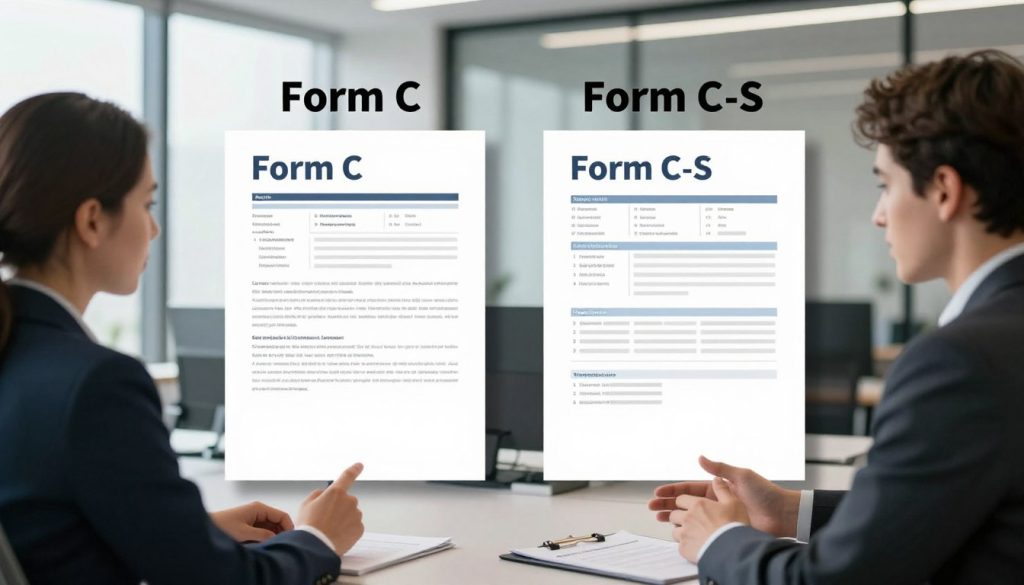
The table shows that a company’s size and complexity are key. For example, small businesses with simple finances might use Form C-S (Lite). But, bigger or more complex companies might need Form C.
Knowing these differences is important. It helps you follow IRAS rules and avoid penalties.
Form C-S (Lite): The Ultimate Shortcut for Micro-Businesses
Micro-businesses can use Form C-S (Lite) to meet their IRAS filing needs quickly. This easy form is made for small businesses. It helps them follow tax rules without hassle.
Is Form C-S Lite applicable for my business?
To see if your business fits Form C-S (Lite), check the IRAS rules. For more info on company secretary needs in Singapore, visitthis link.
Why it’s great
Form C-S (Lite) is perfect for small businesses because it’s simple. It asks for less info than the regular Form C-S or Form C. This makes filing taxes easier for small businesses.
| Criteria | Form C-S (Lite) Requirements |
|---|---|
| Annual Revenue | Not more than $500,000 |
| Business Structure | Sole Proprietorship or Company |
| Filing Requirements | Simplified income statement |

Using Form C-S (Lite) saves time and money for micro-businesses. It’s great for small businesses wanting to make filing easier.
Form C-S: The Standard for Most Singapore Startups
For most startups in Singapore, Form C-S is the go-to for tax filing. It’s made to make tax filing easier for businesses that fit certain criteria. This makes it a great choice for many startups.
The Inland Revenue Authority of Singapore (IRAS) has rules for who can use Form C-S. Knowing these rules is key to seeing if Form C-S is right for your startup.
Form C-S Qualifying Conditions 2026
To qualify for Form C-S in 2026, your business must meet these conditions:
| Condition | Description |
|---|---|
| Revenue Threshold | Your company’s revenue must not exceed SGD 5 million in the financial year. |
| Business Structure | The company must be a Singapore tax resident and not part of a multinational group. |
| Accounting Period | The company’s accounting period must be 12 months. |
As the IRAS says, “Companies that meet the conditions can file a simpler tax return (Form C-S) instead of the full one (Form C).” This makes things easier for eligible startups.
“The simplified tax return is designed to reduce the compliance burden on smaller companies, allowing them to focus on their core business activities.”
The Dealbreakers:
While Form C-S works for many startups, it’s not for everyone. If your business has complex taxes or makes more than SGD 5 million, you might need another form.
- Complex tax structures or transactions
- Revenue exceeding SGD 5 million
- Being part of a multinational group
Knowing these exceptions is important. It helps you follow IRAS rules and avoid fines.
Form C: The Heavyweight for Complex or Large Entities
Form C is key for complex or big companies in Singapore. It’s for those with tricky financial setups or big operations. This form makes sure their money dealings are clear and follow tax rules.
Form C is not easy. It needs a deep understanding of a company’s money matters. Its complexity is because it demands detailed reports from big players in the economy.
Who must file Form C
Not every company in Singapore must use Form C. The IRAS says certain companies need it for their taxes. These include:
- Companies with a turnover over $10 million.
- Companies with complex money dealings.
- Companies that need a tax audit.
This shows who needs Form C. It’s for big economic players to follow tax rules.
Corporate tax Form C filing requirements
Using Form C for e-filing tax returns has important steps and needs. Companies must have all their financial info ready.
| Requirement | Description |
|---|---|
| Financial Statements | Audited financial statements that follow Singapore’s money reporting standards. |
| Tax Computation | A detailed look at taxable income, including income not taxed and expenses not deductible. |
| Transfer Pricing Documentation | Proof that shows fair prices in deals with related parties. |
Knowing and following these rules helps companies file their taxes smoothly with Form C.
Special Case: Filing a Tax Return for a Dormant Company
Singapore companies that are dormant must know their tax filing duties. This is to avoid penalties. Even if a company isn’t making money, it must follow the Inland Revenue Authority of Singapore (IRAS) rules.
Just because your company didn’t make money doesn’t mean you can ignore IRAS.
Dormant companies often think they don’t have to file tax returns. But, the IRAS says all companies must file, even if they’re not active.
Filing tax returns is key to staying in good standing with the IRAS. Not filing can lead to fines and penalties.
The Rule: Unless granted a waiver, a dormant company must e-file its Form C-S/C.
Dormant companies must e-file Form C-S or Form C, depending on their situation. The choice depends on their income and other factors.
| Company Status | Required Form | Conditions |
|---|---|---|
| Dormant with no income | Form C-S | No income and no claim for expenses |
| Dormant with income or expenses | Form C | Income or expenses to be reported |
How to get a waiver
To get a waiver, a dormant company must apply online with the IRAS. It must meet certain criteria, like having no income or assets and not doing business.
The application process requires submitting the needed info and documents to the IRAS. If approved, the company won’t have to file tax returns for that time.
2026 Deadlines & How to File
It’s important to know the deadlines and how to file your Singapore company’s tax return. This is key to following IRAS rules in 2026. Companies must file on time to avoid fines.
The e-filing deadline is November 30th for companies with a year-end between January 1 and May 31. For those with a year-end between June 1 and December 31, it’s within 3 months after the year-end. For example, a December 31, 2025, year-end means filing by March 31, 2026.
- Register for CorpPass: Make sure you have a valid CorpPass for IRAS e-services access.
- Prepare necessary documents: Collect all needed financial documents, like your company’s financial statements and tax forms.
- Complete Form C, C-S, or C-S (Lite): Pick the right form based on your company’s status and filing needs.
- E-file through IRAS e-services: Log in to the IRAS website and follow the steps to e-file.
Tax experts say, “On-time and correct e-filing is vital to avoid fines and meet IRAS rules.”
Companies that are not active must also e-file their tax returns. They need to submit the right form (C-S or C) and provide the needed documents.
By knowing the deadlines and following the e-filing steps, Singapore companies can stay in line with tax laws. This helps them avoid fines.
Don’t Want to Deal With the Hassle? Let Hub Handle It
Filing corporate tax returns can be very hard and take a lot of time. This is true for companies with many financial deals or complex tax issues. In Singapore, figuring out Form C vs. Form C-S can be really tough.
Letting Hub handle your corporate tax filing can make things easier. They use their expert knowledge to make sure you follow tax rules correctly. This helps avoid fines and penalties.
When Hub takes care of your tax filing, you can focus on what you do best. This makes the tax process smoother and gives you peace of mind. You know experts are taking care of your financial needs.
FAQ
What is the main difference between Form C-S and Form C-S (Lite)?
My company is currently dormant. Do I need to file a tax return with IRAS?
Which companies need to file the more complex Form C?
What are the specific qualifying conditions for Form C-S for the 2026 Year of Assessment?
What is the deadline for filing corporate tax returns in 2026?
How can I apply for a waiver if my company has no business activity?
Can a professional service like Hub manage the entire tax filing process for my startup?
Simplify your business compliance today.
Navigating Singapore’s regulatory landscape doesn’t have to be a solo journey. From seamless incorporation to complex tax advisory, Hub is the partner you can count on. Call us today at +65 8121 2113
STAY IN THE LOOP
Subscribe to our free newsletter.
Of all the statutory deadlines a Singapore company director must [...]

Did you know that a single in-house bookkeeping hire in [...]