by Jelina Rosin
Share
by Jelina Rosin
Share

Singapore is consistently ranked as one of the easiest places in the world to do business. The tax incentives are highly favorable, the legal framework is bulletproof, and the registration process is entirely digital.
Whether you are a local entrepreneur ready to formalize your side hustle, or a foreign founder looking to establish an Asian headquarters, understanding how to register your company is your first critical step.
However, “easy to register” does not mean “impossible to mess up.” This guide breaks down exactly what you need to know to get your business legally registered, compliant, and ready to scale—without the legal jargon.
Why Register a Company in Singapore
Registering your business isn’t just about following the law; it is about unlocking the tools you need to grow. An unregistered business is severely capped in its potential.

Legal Recognition and Credibility
A registered company establishes your professional credibility in the marketplace. Clients, suppliers, and partners view registered entities as more trustworthy and stable compared to unregistered operations. This credibility becomes particularly valuable when negotiating contracts or seeking business partnerships.
Your registered business receives a Unique Entity Number from ACRA. This identifier serves as your company’s official recognition by the Singapore government. Banks, government agencies, and business partners require this number for all formal transactions.
Access to Corporate Banking
Opening a corporate bank account requires proper business registration. Financial institutions in Singapore mandate that you present your business profile, incorporation documents, and company details before they process your banking application. Without registration, you cannot separate personal and business finances effectively.
A corporate bank account enables professional financial management. You can receive payments from international clients, process business transactions, and maintain clear accounting records that satisfy regulatory requirements.
Tax Advantages
Private limited companies enjoy significant tax benefits in Singapore. New companies qualify for tax exemption schemes that reduce their corporate tax burden substantially during initial years.
- First S$100,000 of chargeable income receives 75% tax exemption
- Next S$100,000 receives 50% tax exemption
- No capital gains tax on business assets
- Extensive double taxation agreements with over 90 countries
Grant Eligibility
Government grants and support schemes exclusively serve registered businesses. These programs provide substantial financial assistance for growth, innovation, and expansion.
- Startup SG Founder for early-stage funding
- Enterprise Development Grant for business growth
- Productivity Solutions Grant for technology adoption
- Market Readiness Assistance for overseas expansion
Foundation for Growth
Registered companies can hire employees, lease commercial space, protect intellectual property, and expand operations regionally. The corporate structure provides flexibility to raise capital through equity investment or bank financing. Foreign investors and venture capitalists strongly prefer investing in properly registered entities rather than informal businesses.
Your company can enter into legally binding contracts, sue or be sued, and conduct business activities under its own name. This separate legal identity protects your personal assets from business liabilities in most circumstances.
Ready to Establish Your Singapore Business?
Skip the complexity and paperwork. Our Singapore experts handle your complete company registration process, ensuring compliance and speed.
Choose the Right Business Structure for Your Singapore Company
Selecting the appropriate business structure represents one of your most important early decisions. Your choice affects taxation, liability protection, regulatory obligations, and growth potential. Each structure serves different business models and entrepreneurial goals.

Understanding these differences helps you make an informed decision that aligns with your business objectives and risk tolerance. Most entrepreneurs choose between four main structures available in Singapore.
Comprehensive Business Structure Comparison
| Structure | Best For | Ownership Limits | Liability Protection | Tax Benefits | Compliance | Scalability |
| Sole Proprietorship | Freelancers, consultants, side businesses | Single owner only | None – personal liability for all debts | Limited – no corporate tax perks | Low – minimal annual filings | Limited – cannot add investors |
| Private Limited Company | Startups, growing businesses, foreign entrepreneurs | 1 to 50 shareholders | Full – separate legal entity | Extensive – tax exemptions and rebates | Moderate – AGM, returns, secretary required | High – ideal for funding and expansion |
| Limited Liability Partnership | Professional service firms, design agencies | Minimum 2 partners | Partial – partners liable for own acts | Limited – fewer grant options | Moderate – some annual requirements | Moderate – less attractive to investors |
| Limited Partnership | Investment vehicles, project-based setups | 1 general + 1 limited partner minimum | Mixed – general partner fully liable | None – no corporate tax advantages | Low – minimal ongoing obligations | Low – niche use cases only |
Sole Proprietorship: Simple but Limited
A sole proprietorship suits individual entrepreneurs who want to test business ideas with minimal formality. Registration costs remain low, and ongoing compliance requirements stay simple. You maintain complete control over business decisions and operations.
However, this structure offers no separation between personal and business assets. Creditors can pursue your personal property to satisfy business debts. You cannot bring in partners or investors without restructuring your entire business entity.
Private Limited Company: The Growth Choice
Most serious entrepreneurs register a private limited company for their Singapore business. This structure provides liability protection, separating your personal assets from business obligations. The company exists as a legal entity independent of its shareholders and directors.
Private limited companies qualify for comprehensive tax benefits and government grants. You can bring in multiple shareholders, issue shares to investors, and raise capital efficiently. Foreign ownership remains unrestricted, allowing 100% overseas shareholding.
The trade-off involves higher compliance requirements. You must appoint a company secretary within six months of incorporation, maintain a registered office address in Singapore, and hold annual general meetings unless exempted. Annual returns and financial statements require submission to ACRA.
Limited Liability Partnership: Professional Services Focus
LLPs work well for professional service providers like lawyers, accountants, architects, and consultants. Partners enjoy some liability protection while maintaining partnership flexibility. Each partner remains liable for their own professional negligence but not for other partners’ actions.
This structure requires at least two partners who must be individuals. LLPs face restrictions on certain grants and tax incentives compared to private limited companies. Most venture capitalists and institutional investors prefer not to invest in LLP structures.
Limited Partnership: Specialized Investment Use
Limited partnerships serve niche purposes, primarily for investment funds and project-specific ventures. The structure requires at least one general partner with unlimited liability and one limited partner whose liability caps at their capital contribution.
This arrangement rarely suits standard business operations. Most entrepreneurs find private limited companies or sole proprietorships more appropriate for their needs.
Hub Recommendation: For most entrepreneurs planning to grow, hire employees, or raise capital, a private limited company offers the best balance of protection, credibility, and opportunity. Foreign entrepreneurs find this structure particularly advantageous due to unrestricted ownership and access to Singapore’s international business network.
Making Your Structure Decision
Consider these factors when choosing your business structure:
- Your growth ambitions and funding needs
- Desired liability protection level
- Tax planning objectives
- Number of co-founders or partners
- Industry-specific requirements
- Your willingness to handle compliance obligations
- Plans for employee hiring
- International expansion aspirations
Need Help Choosing Your Business Structure?
Our experienced consultants provide personalized recommendations based on your business goals, industry, and growth plans. Get expert guidance before making this crucial decision.
Essential Requirements to Register a Company in Singapore
Proper preparation streamlines your company registration process significantly. Gathering all required documents and information before starting your application prevents delays and reduces the likelihood of rejection.
Requirements vary slightly depending on your chosen business structure. For a private limited company, which represents the most popular choice among entrepreneurs, you need the following elements in place.
1. Company Name Selection
Your company name must be unique and comply with ACRA naming guidelines. The name cannot be identical or too similar to existing registered entities. It must not contain restricted or offensive words without proper approval.
Name reservation through Bizfile costs S$15 and remains valid for 120 days. During this period, no other entity can register using your approved name. Choose a name that reflects your business identity while remaining professional and memorable.
Avoid names that suggest government affiliation, banking activities, or regulated industries unless you hold appropriate licenses. Names containing words like “bank,” “insurance,” or “university” require special approval from relevant authorities.
2. Local Director Requirement
Every private limited company must have at least one director who is ordinarily resident in Singapore. This requirement ensures local accountability and facilitates regulatory oversight.
Eligible individuals include Singapore citizens, permanent residents, and holders of valid employment passes or entrepreneurship passes. The director must be at least 18 years old and not be disqualified from directorship under the Companies Act.
Foreign entrepreneurs without Singapore residency can appoint a nominee director or obtain an entrepreneur pass to fulfill this requirement. The director holds legal responsibilities for company compliance and proper governance.

3. Shareholder Details
A private limited company requires at least one shareholder, who can be an individual or corporate entity. Shareholders may be local or foreign, with no restrictions on foreign ownership percentages. You can have up to 50 shareholders in a private limited company structure.
Shareholders own the company through their equity holdings. They receive profits through dividends and hold voting rights on major company decisions. The director and shareholder can be the same person for small businesses.
4. Company Secretary Appointment
Singapore law mandates that every private limited company appoint a company secretary within six months of incorporation. The secretary must be a natural person residing in Singapore who understands their duties under the Companies Act.
Company secretaries handle statutory filings, maintain company registers, organize board meetings, and ensure regulatory compliance. Professional company secretary services provide expertise and relieve directors of administrative burdens.
5. Registered Office Address
Your company needs a physical registered address in Singapore where ACRA and other authorities can send official correspondence. This address must be accessible during normal business hours and cannot be a post office box.
Many entrepreneurs use virtual office services or professional registered address providers. This solution offers cost savings compared to leasing dedicated office space, particularly for early-stage businesses or foreign entrepreneurs.
6. Share Capital Structure
Singapore requires a minimum paid-up capital of just S$1 for private limited companies. This low barrier enables entrepreneurs to start businesses without substantial upfront capital. You can increase share capital later as your business grows and requires additional funding.
Share capital represents the total value of shares issued to shareholders. Companies typically issue ordinary shares, though preference shares and other classes remain available for complex ownership structures. Currency can be Singapore dollars or any foreign currency.
7. SSIC Code Selection
The Singapore Standard Industrial Classification code categorizes your primary business activity. This classification affects regulatory requirements, licensing needs, and statistical reporting. Choose the SSIC code that most accurately describes your main business operations.
Companies can have multiple SSIC codes if they engage in diverse business activities. Primary and secondary codes help authorities understand your business scope and apply appropriate regulations.
8. Company Constitution
Your company constitution outlines governance rules, shareholder rights, director powers, and operational procedures. New companies can adopt ACRA’s standard constitution template or create customized articles of association.
The standard constitution works well for most small businesses and startups. Companies with complex ownership structures, specific governance preferences, or investor requirements may need customized constitutions drafted by lawyers.
Document Checklist: Before starting your registration, verify you have identification documents (NRIC, FIN, or passport) for all directors and shareholders, proof of registered address, approved company name, chosen SSIC codes, and decided share capital structure. Having these ready accelerates the registration process substantially.
Step-by-Step Guide: How to Register a Company in Singapore
The company registration process in Singapore operates entirely online through ACRA’s Bizfile portal. This digital system enables efficient processing and quick approval for most applications. Follow these detailed steps to complete your business registration successfully.

Step 1: Verify Name Availability
Begin by searching the Bizfile database to confirm your preferred company name remains available. The search function shows existing names and helps you avoid conflicts. Singapore requires company names to be distinctive and not misleading.
Once you identify an available name that meets ACRA requirements, submit a name reservation application. The S$15 fee secures your chosen name for 120 days, giving you time to complete the incorporation process without risk of another entity claiming your name.
Step 2: Prepare Required Documents
Compile all necessary documentation before beginning your application. You need identification documents for directors and shareholders, proof of registered address, completed consent forms from all company officers, and your chosen company constitution.
Ensure all foreign documents carry proper translations and notarization where required. Having complete documentation ready prevents application delays and reduces rejection risk.
Step 3: Access Bizfile Portal
Log into the Bizfile system using your Singpass or CorpPass credentials. Foreign applicants without these accounts may need to engage a registered filing agent to submit applications on their behalf.
Navigate to the company incorporation section and select “Register a New Company.” The system guides you through required information fields systematically.
Step 4: Complete Application Forms
Enter comprehensive details about your company structure, business activities, and key personnel. Provide accurate information about company name, registered address, share capital, SSIC codes, and business objectives.
Add details for all directors and shareholders, including full names, identification numbers, residential addresses, and contact information. Specify shareholding percentages and share capital contributions for each shareholder.
Upload required documents including identity verification, address proof, and consent forms. The system validates your entries and flags any missing or incorrect information.
Step 5: Appoint Company Officers
Formally appoint your company secretary and auditor through the Bizfile system. While you have six months to appoint a secretary after incorporation, completing this step during registration ensures full compliance from day one.
Small companies qualifying for audit exemption may skip auditor appointment. Most startups and small businesses meet exemption criteria, which include annual revenue below S$10 million and total assets below S$10 million.
Step 6: Review and Submit
Carefully review all entered information before final submission. Errors or inconsistencies may lead to application rejection and require resubmission. Verify that all names, numbers, and addresses match supporting documents exactly.
The system displays a summary of your application including all fees. Current registration fees total S$315 for private limited companies, including S$15 for name reservation and S$300 for incorporation.
Step 7: Make Payment
Complete payment through the Bizfile portal using available electronic payment methods. The system accepts major credit cards, debit cards, and direct bank transfers. Payment confirmation triggers immediate application processing.
Step 8: Await ACRA Approval
ACRA typically processes standard applications within one to three business days. Complex applications involving restricted names, unusual business activities, or incomplete documentation may require additional processing time.
You receive email notifications regarding your application status. ACRA may request additional information or clarification during processing. Respond promptly to any such requests to avoid delays.
Step 9: Receive Incorporation Documents
Upon approval, ACRA issues your Certificate of Incorporation electronically. Your company officially exists from the incorporation date shown on the certificate. You also receive your Unique Entity Number, which serves as your company’s official identifier for all business transactions.
Download and save your Bizfile Business Profile, which contains your complete company details. Banks, government agencies, and business partners frequently request this document.
Registration Fees Breakdown
- Name reservation: S$15
- Company incorporation: S$300
- Total government fees: S$315
- Additional costs: Company secretary, registered address, professional services (varies by provider)
Typical Processing Timeline
- Name approval: Instant to 1 business day
- Application processing: 1-3 business days
- Complex cases: Up to 14 business days
- Total timeline: Typically 1-5 business days from submission to incorporation
Let Experts Handle Your Singapore Company Registration
Why navigate the complexity alone? Hub Corporate Services manages your entire incorporation process from name reservation to document filing. We ensure accuracy, speed, and full compliance with Singapore regulations.
Registration Timeline and Cost Considerations
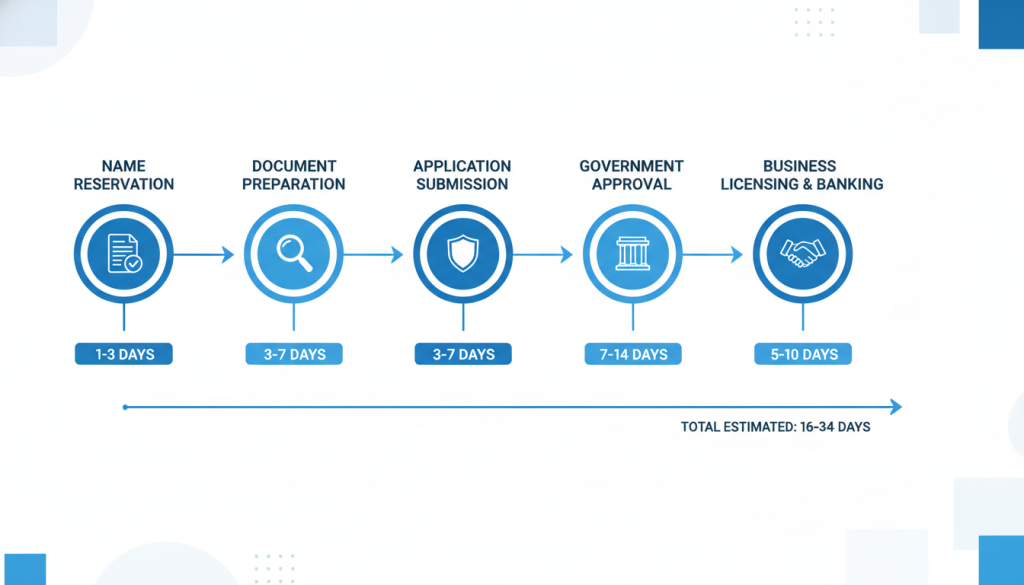
Understanding the timeframe and financial requirements for company registration helps you plan effectively. Singapore offers one of the fastest business registration processes globally, though actual timelines vary based on several factors.
Expected Registration Timeline
Standard private limited company registrations typically complete within one to three business days after submission. This remarkably fast processing reflects Singapore’s commitment to ease of doing business and efficient public services.
Several factors can extend this timeframe. Applications involving restricted words in company names require additional scrutiny and approval from relevant ministries. Companies planning regulated activities like financial services, education, or healthcare need special licenses that add processing time.
Foreign directors without Singapore residency may face longer processing as ACRA conducts additional verification. First-time business owners sometimes experience delays due to incomplete or incorrect documentation. Working with experienced professionals helps avoid these common pitfalls.
Government Registration Fees
ACRA charges straightforward fees for company registration with no hidden costs. Name reservation requires S$15, while company incorporation costs S$300. These fees remain consistent regardless of share capital or company size.
Sole proprietorships cost less to register at S$115 for one year or S$175 for three years. However, most growth-oriented entrepreneurs find the additional S$140 for private limited company registration worthwhile given the substantial benefits.
Ongoing Service Costs
Beyond registration fees, consider ongoing service requirements. Company secretary services typically cost S$600-S$1,200 annually depending on provider and service level. Registered address services range from S$300-S$800 per year for virtual office solutions.
Accounting and bookkeeping services vary widely based on transaction volume and complexity. Small businesses might spend S$200-S$500 monthly while larger operations with complex needs pay more. Annual financial statement preparation and tax filing typically cost S$1,000-S$3,000 for small companies.

Hidden Costs to Consider
Factor in expenses beyond obvious registration fees. Bank account opening sometimes requires minimum deposits ranging from S$1,000 to S$3,000 depending on the bank and account type. Corporate bank accounts may carry monthly fees or transaction charges.
Business licenses and permits add costs for regulated industries. GST registration becomes mandatory once annual revenue exceeds S$1 million. Professional indemnity insurance, cyber liability coverage, and other business insurance policies protect your company but require budget allocation.
Cost Comparison: DIY Versus Professional Services
| Service Component | DIY Approach | Professional Service | Value Difference |
| ACRA Registration Fees | S$315 | S$315 (same) | No difference |
| Company Secretary (Annual) | S$600-S$1,200 | Often included in package | Bundled savings |
| Registered Address (Annual) | S$300-S$800 | Often included in package | Bundled savings |
| Compliance Guidance | Self-research time cost | Expert advice included | Reduced risk, saved time |
| Error Correction | Potential penalties, delays | Accuracy guaranteed | Peace of mind |
| Total First Year Cost | S$1,215-S$2,315 | S$650-S$1,500 (packages) | Often more cost-effective |
Budget Planning Tips
Create a realistic budget that covers both initial setup and first-year operations. Include registration fees, professional services, banking costs, insurance, licenses, and contingency funds. Many entrepreneurs underestimate post-incorporation compliance costs.
Professional incorporation services often provide better value than DIY approaches when you account for time savings, expertise, reduced error risk, and bundled service packages. Compare total costs including hidden expenses rather than focusing solely on registration fees.
Cost Warning: Cutting corners on professional services may lead to compliance issues that cost significantly more to resolve later. Penalties for late filings, incorrect returns, or regulatory violations often exceed the cost of proper professional guidance from the start.
Hub Corporate Services combines technology efficiency with personal expertise to deliver streamlined company registration. Our platform simplifies the process while our specialists ensure accuracy and regulatory compliance at every step.
We handle your complete incorporation including company name reservation, document preparation, ACRA filing, and certificate collection. Our packages include mandatory company secretary appointment and registered address provision, eliminating the need to source these services separately.
Unlike traditional firms with opaque pricing and lengthy processes, Hub offers transparent package pricing and fast turnaround times. You receive modern, responsive service that matches Singapore’s reputation for efficiency and innovation.
Our ongoing support extends beyond incorporation. Clients access expert guidance for compliance questions, annual filing requirements, tax obligations, and business growth challenges. This relationship-based approach ensures you have trusted advisors throughout your entrepreneurial journey.
| Factor | DIY on Bizfile | Hub Services | Traditional Firms |
| Time Investment | High – 5-10 hours personal time | Minimal – 30 minutes consultation | Moderate – multiple meetings required |
| Complexity Management | Self-research required | Expert guidance included | Expert guidance but slower |
| Accuracy Guarantee | Self-responsibility for errors | Professional accuracy assured | Professional accuracy assured |
| Cost Transparency | Government fees only (S$315) | Clear package pricing from S$650 | Often S$800+ with hidden fees |
| Ongoing Support | None – source separately | Continuous expert access | Limited to business hours |
| Secretary & Address | Find separate providers | Included in packages | Often charged separately |
| Digital Experience | Government portal interface | Modern platform and apps | Often offline processes |
| Best For | Time-rich, cost-sensitive, simple structures | Time-poor entrepreneurs wanting modern, efficient service | Those preferring established, conventional approaches |
Foreign Entrepreneur? We Specialize in Your Unique Needs
Hub has helped thousands of foreign entrepreneurs successfully establish businesses in Singapore. We handle local director arrangements, registered addresses, and guide you through banking and work pass requirements.
Simplify your business compliance today.
Navigating Singapore’s regulatory landscape doesn’t have to be a solo journey. From seamless incorporation to complex tax advisory, Hub is the partner you can count on. Call us today at +65 8121 2113
STAY IN THE LOOP